
St. Petersburg, FL is Becoming an AI SaaS Hub and Investors are Watching
Billions in venture capital. Corporate HQ relocations from New York and San Francisco. A new generation of AI startups launching from Tampa Bay. The data tells a clear story, confirmed by my eyes on the ground.
Key Takeaways
- Florida startups pulled in $2.85B in venture capital in just the first half of 2025, with AI-focused companies alone drawing $830M in the Miami metro — nearly matching all of 2024 in six months.
- Major corporations are relocating to Florida at an accelerating pace: Microsoft, Amazon, ServiceNow, Anaplan, Citadel, and Varonis all moved or expanded significant operations in 2024–2025, drawn by zero state income tax and operating costs 30–40% lower than Silicon Valley.
- Tampa Bay is emerging as “Cyber Bay.” USF launched the nation’s first college dedicated to AI + cybersecurity (backed by a record $40M gift), while UF opened a $150M+ AI facility powered by an NVIDIA supercomputer.
- Startup incubators like ARK Innovation Center in St. Petersburg, FL boast huge growth from startups in the AI, robotics, fintech, and broader SaaS industries. For example, the $85B+ global SEO software market is rapidly transitioning into AEO/GEO and companies like Cairrot (located at the ARK Innovation Center) signed 100+ customers in its first 60 days thanks in part to communities like this.
- On the ground in Tampa/St. Pete, the signals are everywhere: Cathie Wood relocated ARK Invest’s HQ and funded a $16M startup incubator, luxury condos are going up across the skyline, and premium lifestyle infrastructure is being built to support the influx of high-earning tech talent.
Something significant is happening in Florida. Not the kind of thing that shows up overnight and disappears with the next news cycle — this is structural. Capital is flowing in. Companies are relocating. Universities are investing hundreds of millions of dollars in AI infrastructure. And the talent pipeline is being built to sustain all of it for decades.
I’ve watched this transformation happen firsthand from St. Petersburg, where I cofounded and launched Cairrot, an AI search visibility and analytics platform. When people ask me why I chose to build here instead of Austin or San Francisco, the answer starts with data — and ends with what I see every day walking through the Innovation District.
Let me walk you through both.
The Numbers Behind Florida’s Tech Boom
Florida is now the fifth-largest state for tech employment in the country. According to Visual Capitalist’s 2025 analysis of Bureau of Labor Statistics data, Florida had 161,000 tech jobs — putting it in a top tier alongside California, New York, Texas, and Washington. CompTIA’s 2025 State of the Tech Workforce report confirmed that Florida was among the states with the largest net tech employment gains during the 2024 reporting period, with Orlando ranking among the top metros nationally for tech job growth.
The tech sector’s contribution to Florida’s economy is substantial. CompTIA data indicates that technology contributes roughly $71 billion to the state’s economy, and tech wages in Florida run about 86% higher than the state’s median across all occupations. One analysis projects AI-related employment in Florida growing at 35% annually through 2026 — a figure that reflects both direct AI roles and positions requiring significant AI interaction.
Venture Capital Is Flowing, Especially Into AI
The venture capital story might be the most compelling part of Florida’s tech ascent. According to the eMerge Insights Florida Venture Capital 1H 2025 Report, Florida startups attracted $2.85 billion across 270 deals in the first half of 2025 alone, putting the state on pace for its best year since the 2022 high. South Florida dominated, drawing over $2 billion across 161 deals — well on its way to surpassing 2024’s full-year result of $2.77 billion.
AI is the dominant force behind these numbers. The amount of venture capital flowing to AI-focused startups in the Miami metro during the first half of 2025 — $830 million — nearly matched the total for all of 2024. Statewide, roughly a third of all funded companies cited AI as a core vertical. As one active investor put it in the eMerge report, if you’re not investing in AI currently, you’re missing the most exciting period in the history of venture.
Among U.S. metros, the Miami-Fort Lauderdale area ranked seventh nationally for both deal value and number of deals. Among states, Florida ranked sixth for deal value and fifth by number of deals. These aren’t emerging-market figures — this is legitimate top-tier venture activity.
The Corporate Migration Wave
The capital isn’t just coming from VC. Major corporations have been relocating headquarters and opening significant operations across Florida at a pace that would have been unthinkable a decade ago.
In 2024 and 2025 alone, the list of companies planting flags in South Florida reads like a Fortune 500 roster: Microsoft consolidated its Latin American operations in Miami’s Brickell district. Amazon expanded corporate and technology operations into Wynwood. Anaplan relocated its global headquarters from San Francisco to Miami. Citadel continued accelerating its growth following its headquarters move. ServiceNow, a Fortune 500 enterprise AI company, announced a new regional headquarters and AI innovation hub in West Palm Beach. Varonis, a cybersecurity and data analytics firm, moved its global headquarters from New York to Miami. DigitalBridge, a digital infrastructure investment firm, relocated to Palm Beach County.
The pull factors are consistent across all of these moves: zero state income tax, reduced corporate tax rates, R&D credits, and business operating costs that run 30-40% lower than Silicon Valley. Miami’s position as a gateway to Latin American markets adds another layer of strategic value. And the investor base has deepened considerably as funds and operators have relocated from traditional tech hubs — bringing networks, deal flow, and institutional knowledge with them.
Tampa Bay: The “Cyber Bay” Corridor
While Miami dominates the headlines, the Tampa Bay region is quietly building one of the most compelling tech corridors in the country — particularly at the intersection of AI and cybersecurity.
More than 25% of Florida’s tech jobs are concentrated in the Tampa area, including the headquarters or major offices of cybersecurity leaders like KnowBe4, ReliaQuest, Rapid7, and ConnectSecure. Lightcast’s 2025 Talent Attraction Scorecard ranked the Tampa metro area eighth among large U.S. metros for its ability to attract prime-age, high-earning, college-educated workers.
The anchor of this momentum is the University of South Florida’s Bellini College of Artificial Intelligence, Cybersecurity and Computing. Backed by a record-setting $40 million gift from tech entrepreneur Arnie Bellini — the largest in USF’s nearly 70-year history — this is the first named college in the nation dedicated exclusively to the convergence of AI and cybersecurity. The college launched in fall 2025 with 3,000 students and 45 faculty members, with plans to grow to 5,500 students within three years.
Meanwhile, the University of Florida opened Malachowsky Hall, a $150+ million, 263,000-square-foot facility for data science and AI that was built with contributions from NVIDIA co-founder Chris Malachowsky, NVIDIA itself, and a $110 million investment from the state of Florida. UF also hosts HiPerGator, one of the most powerful AI supercomputers in the country, funded by a $50 million combined donation from Malachowsky and NVIDIA. UF has since added over 110 AI faculty members, extending AI-focused coursework across all of its 55,000 students.
The Florida Chamber of Commerce has stated that AI adoption is central to the state’s goal of becoming a top-10 global economy by 2030 and ranking among the top three states for R&D investment and patents. These aren’t aspirational press releases — they’re being backed with real infrastructure.
An Example: The $85B+ SEO SaaS Market Is Becoming the AEO Market
To understand why I chose to build Cairrot in this moment, you need to understand the market shift happening underneath the broader Florida tech story.
The global SEO software market is enormous. Multiple research firms estimate it at roughly $75-85 billion as of 2024-2025, with projections to reach anywhere from $155 billion to $266 billion by the end of the decade, growing at compound annual rates of 13-14%. The U.S. alone accounts for about $23.5 billion of that. North America leads globally, commanding about 35% of total SEO services revenue.
But here’s the thing: this market is undergoing a fundamental transformation. The discipline of “search engine optimization” is evolving into what the industry now calls AEO (answer engine optimization) and GEO (generative engine optimization). The mechanics are straightforward — consumers are increasingly using AI tools like ChatGPT, Gemini, Perplexity, and Claude to research buying decisions instead of (or alongside) traditional Google searches. ChatGPT alone now processes billions of queries per day and is one of the most visited websites on the internet. AI Overviews are appearing in a majority of Google searches in the U.S. When people search differently, brands need to optimize differently.
The emerging GEO services market was valued at approximately $886 million in 2024, with projections to grow to $7.32 billion by 2031 at a 34% compound annual growth rate. That’s the early-stage segment of a much larger shift that will eventually redefine the entire SEO software market. Traditional SEO platforms like Semrush, Ahrefs, and BrightEdge are racing to bolt on AI visibility features — Adobe acquired Semrush in late 2025 to bring its GEO capabilities into the Adobe Experience Cloud. The signal is clear: this isn’t a niche. It’s the future of the market.
Cairrot is built for exactly this inflection point. We’re a marketing analytics SaaS focused on AI search visibility — helping brands understand how they appear across LLMs, track their share of voice in AI-generated answers, and optimize their content for citation and recommendation by models like ChatGPT, Claude, and Gemini. We track the metrics that matter in this new landscape: LLM citations, AI Overviews visibility, branded vs. non-branded click share from AI sources, and engagement quality from AI-referred traffic.
We launched in early 2026 and signed on over 100 customers in our first 60 days. Cairrot operates out of the ARK Innovation Center in St. Petersburg — one of the most prominent startup incubators in the greater Tampa Bay area.
Why the ARK Innovation Center In St. Petersburg?
The ARK Innovation Center isn’t just another coworking space. It’s a 45,000-square-foot facility built specifically to support tech startups and entrepreneurs, operated by the Tampa Bay Innovation Center. The project came together through a collaboration between Pinellas County, the City of St. Petersburg, and ARK Invest — the investment firm founded by Cathie Wood, who relocated ARK’s corporate headquarters from Manhattan to downtown St. Petersburg in 2021.
Wood’s move wasn’t just a corporate relocation — it was a statement. ARK contributed $2 million to the center’s construction and put its name on the facility. Wood joined the Tampa Bay Innovation Center’s board of directors. ARK’s research team occupies over 10,000 square feet in the building. The center is located in St. Petersburg’s Innovation District, a collaborative community near downtown that includes USF St. Petersburg, Johns Hopkins All Children’s Hospital, and the U.S. Coastal and Marine Science Center. By 2026, the center was projected to impact Pinellas County by $28 million and support 1,265 direct and indirect jobs.
“I have a feeling that St. Pete is going to become a very powerful beacon for innovation.”
— Cathie Wood, ARK Invest Founder, CEO & CIO
The Advanced Robotics for Manufacturing Institute (ARM), the nation’s leading robotics and AI manufacturing innovation institute, also announced it would be moving to the ARK Innovation Center, adding another layer of deep-tech credibility to the facility.
What I See on the Ground in Tampa Bay & St. Pete
The macro data tells one story. What I see on the ground in Tampa and St. Petersburg every day tells the same story with even more texture.
When investors like Cathie Wood don’t just relocate their corporate headquarters to your city but also fund the construction of a startup incubator and join its board — that’s not speculative interest. That’s conviction capital. And it’s not just the incubator. I’ve noticed investors like Wood and others pouring money into the broader ecosystem around St. Pete — luxury gyms, premium service businesses, high-end amenities that signal a bet on the demographics of the people moving here. When sophisticated investors start investing in the lifestyle infrastructure around a tech corridor, they’re telling you they expect the talent base to grow dramatically.
Perhaps the most visible signal: the sheer volume of luxury condominium construction happening across Tampa and St. Petersburg right now. Drive through downtown St. Pete, the waterfront, or the Warehouse Arts District and you’ll see cranes everywhere. Multiple major residential towers are under construction simultaneously. This kind of development doesn’t happen without deep confidence from developers and their lenders that high-earning professionals — the kind of people who work at tech companies and start them — are coming in volume. Real estate developers and their capital partners don’t build $500-per-square-foot condos on a hunch. They build them on data, demand signals, and lease-up projections. The construction boom is effectively the real estate market’s way of pricing in the tech migration that the venture capital data already confirms.
When you put it all together — the VC flows, the corporate relocations, the university investments, the ARK Innovation Center, the real estate development pipeline — you’re looking at an ecosystem that is being built with intention and backed with real capital at every level. This isn’t a cycle. It’s a structural shift.
Florida Is Where Startups Should Be Looking
Florida is one of the hottest areas in the country for venture capital and private equity to find investment opportunities right now. The data makes that case clearly — $2.85 billion in venture capital in just the first half of 2025, a statewide AI startup boom, and a corporate migration wave that’s bringing Fortune 500 operational infrastructure alongside the startup energy.
But beyond the numbers, what makes Florida — and particularly the Tampa Bay corridor — special for entrepreneurs is the network effect that’s forming. When you operate out of a place like the ARK Innovation Center, you’re not just renting office space. You’re in proximity to other founders building cutting-edge products, to mentors and advisors connected to national venture networks, and to an investor class that has specifically chosen this region because they believe in its trajectory.
For Cairrot, launching here was a strategic decision rooted in everything I’ve outlined above. We’re building at the intersection of AI and marketing analytics — one of the fastest-growing software categories in the world — from a city that is rapidly becoming one of the most compelling startup ecosystems in the country. The SEO software market is transitioning into the AEO era, and the companies that define this new category are going to be built by teams that move fast, stay close to the data, and operate in environments that reward entrepreneurial risk-taking.
Florida is that environment. If you’re an entrepreneur, investor, or builder looking for a place to create — come see what’s happening here. The momentum is real, the capital is flowing, and the best time to get involved was two years ago. The second best time is now.
Track Your AI Search Visibility with Cairrot
Cairrot helps brands measure and optimize how they appear across ChatGPT, Claude, Gemini, Perplexity, and AI Overviews. See how your brand shows up in the new search landscape. Learn more at cairrot.com →
Related Resources
Ahrefs Brand Radar Review (2026): Pricing Breakdown, Competitor Comparisons, and Features Review
Ahrefs Brand Radar Review (2026): Features, Pricing Breakdown, and Competitor Comparisons Generative engine optimization (GEO) expert Connor Kimball shares strategies
Best GEO Strategies in 2026: 32 Ways to Optimize for LLMs and AI Search
Generative Engine Optimization Strategy Guide (2026): 32 GEO Tactics for AI Visibility Generative engine optimization (GEO) expert Connor Kimball shares
Learn More
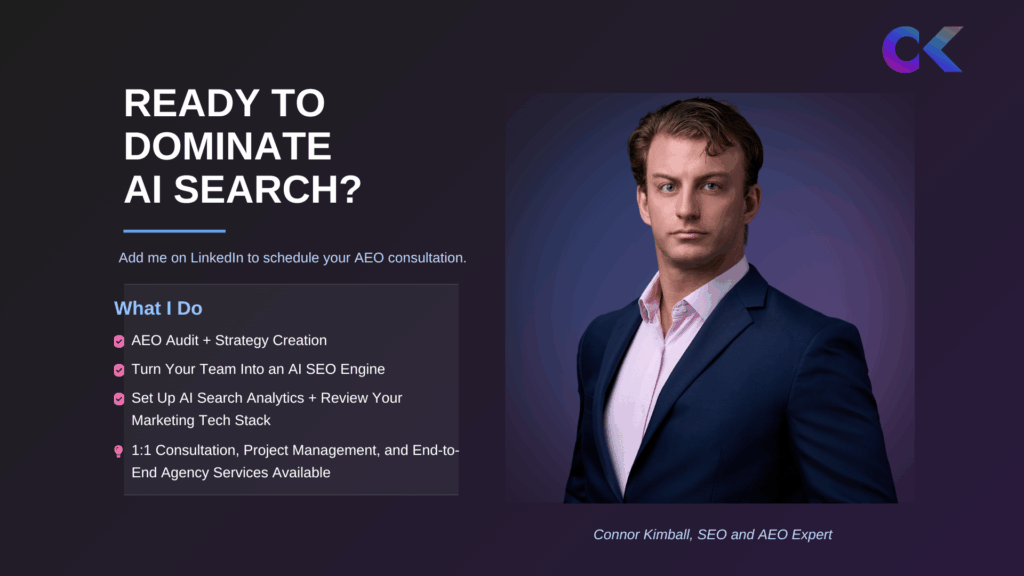
Looking for expert help with your growth strategy? Contact me (Connor Kimball) on LinkedIn to learn how we can dominate LLMs and AI search together ->